1
Selecting a model or automation platform before defining the decision, risk level, data boundary, and success test.
Loading Syncognix
Loading Syncognix
Software robots that handle invoice entry, report generation, and data reconciliation — the repetitive work nobody was hired to love.
Software robots that handle invoice entry, report generation, and data reconciliation — the repetitive work nobody was hired to love.
The goal is not simply to complete a list of tasks. It is to remove a specific operational or customer constraint, prove the result, and leave clear ownership after delivery.
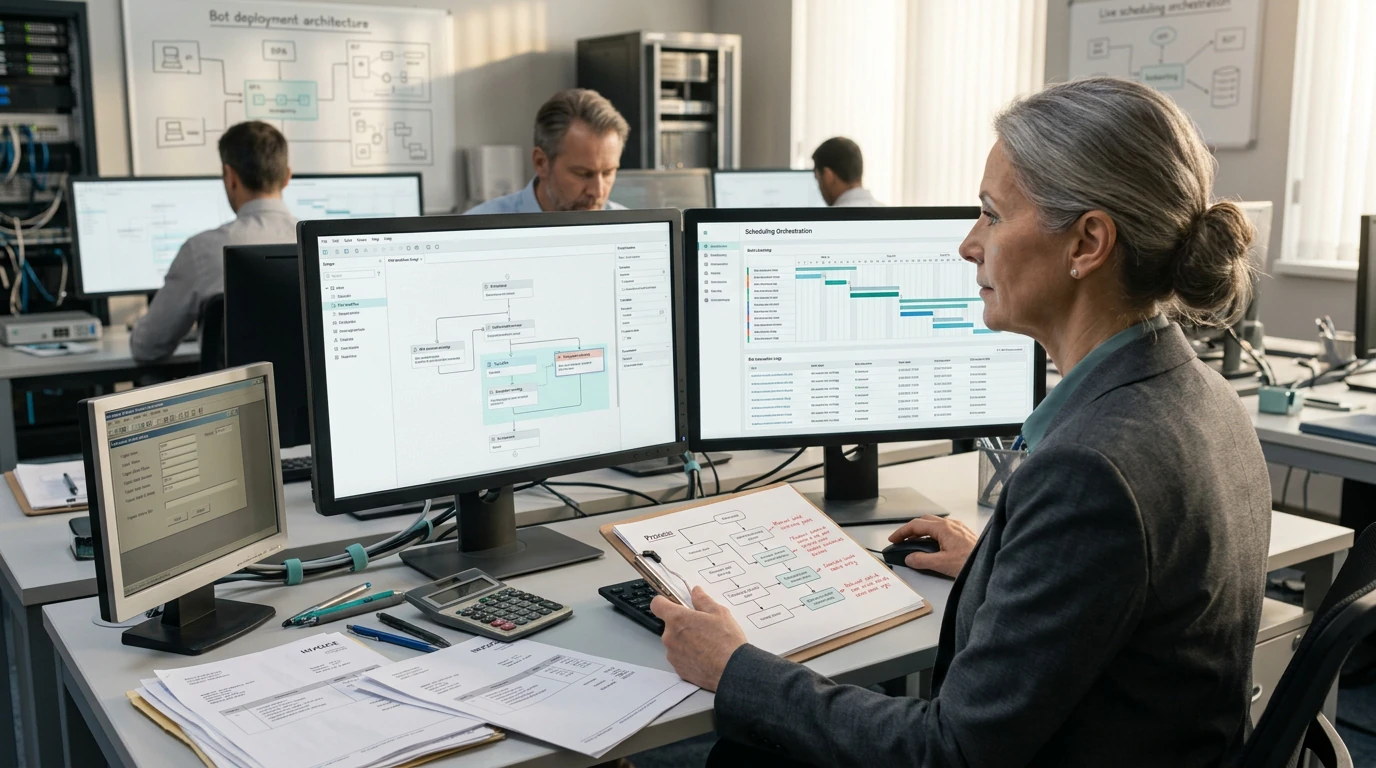
One accountable team connecting the decisions, quality checks, and handoff required for a durable result.
Rekeying invoices, reconciling spreadsheets, downloading-renaming-uploading reports: it's thousands of dollars of skilled salary spent on robot work. RPA does it faster, without typos, at 3 a.m., every night.
Teams automate a broken process, multiplying its exceptions and poor data instead of removing the root cause.
AI demonstrations look convincing but lack grounding, permissions, evaluation, monitoring, and human escalation.
Tool sprawl creates fragile workflows whose ownership, cost, security, and failure behavior are unclear.
We connect diagnosis, scope, execution, validation, and operational ownership. The package changes the depth and scale—not the discipline of the delivery system.
We confirm the desired outcome, users, current state, dependencies, risks, and evidence of success before prescribing back-office rpa (robotic process automation).
We translate process recording and feasibility analysis and bot development with exception handling into visible decisions, responsibilities, milestones, and review criteria.
Delivery moves through reviewable increments with quality checks, exception handling, and stakeholder decisions recorded before they become rework.
We complete runbook and maintenance documentation, confirm handoff and escalation paths, and leave a practical measurement and improvement plan.
Every tier keeps the core controls below. Package level changes the volume, depth, complexity, or operating cadence.
Process recording and feasibility analysis
Bot development with exception handling
Scheduling and orchestration setup
Audit logs of every action taken
Runbook and maintenance documentation
The visible deliverable is rarely the whole system. These are the recurring gaps we design out before they become delay, rework, or risk.
Selecting a model or automation platform before defining the decision, risk level, data boundary, and success test.
Testing only ideal prompts or records while ignoring ambiguity, missing data, misuse, and downstream failure.
Launching without evaluation sets, audit trails, cost limits, fallback behavior, or a named process owner.
Our advantage is not a claim that trade-offs disappear. It is the ability to connect the decisions other providers often split apart, make quality visible, and leave ownership clear.
We begin with the process and risk boundary, then choose the lightest technology that can meet it.
Grounding, permissions, evaluation, observability, human review, and failure recovery are designed together.
The workflow is measured against business outcomes, not demo quality or model output alone.
Scope advantage: The scope makes process recording and feasibility analysis explicit, then connects it to bot development with exception handling; those dependencies are less likely to disappear between separate vendors.
Final targets are set during alignment, using a baseline, a named owner, and a realistic measurement window. Typical measures include:
Hours and cycle time saved
Accuracy, containment, and escalation rate
Cost per completed outcome
Single Process
Secure USD checkout powered by Stripe. By continuing, you agree to our Terms, Refund & Cancellation Policy, and Delivery Policy. Charges appear as SYNCOGNIX.
Department
Secure USD checkout powered by Stripe. By continuing, you agree to our Terms, Refund & Cancellation Policy, and Delivery Policy. Charges appear as SYNCOGNIX.
Program
Secure USD checkout powered by Stripe. By continuing, you agree to our Terms, Refund & Cancellation Policy, and Delivery Policy. Charges appear as SYNCOGNIX.
Not sure which package fits? Build a guided project brief. We will use your goal, current stage, timing, and investment range to recommend the right package or a strategy session.
High-volume, rule-based, and boring: invoice processing, order entry, report distribution, data reconciliation. The consultation includes a quick feasibility screen.
We favor API-level automation where possible (far more stable) and include failure alerts so UI changes are caught and patched fast.
Most single-process bots replace 10–30 staff-hours a month, breaking even inside two quarters. We'll model yours before you buy the build.