1
Configuring objects and automation before agreeing on lifecycle stages, handoffs, data standards, and decisions.
Loading Syncognix
Loading Syncognix
A SharePoint intranet people actually open — news, documents, policies, and team sites structured for findability, not archaeology.
A SharePoint intranet people actually open — news, documents, policies, and team sites structured for findability, not archaeology.
The goal is not simply to complete a list of tasks. It is to remove a specific operational or customer constraint, prove the result, and leave clear ownership after delivery.
One accountable team connecting the decisions, quality checks, and handoff required for a durable result.
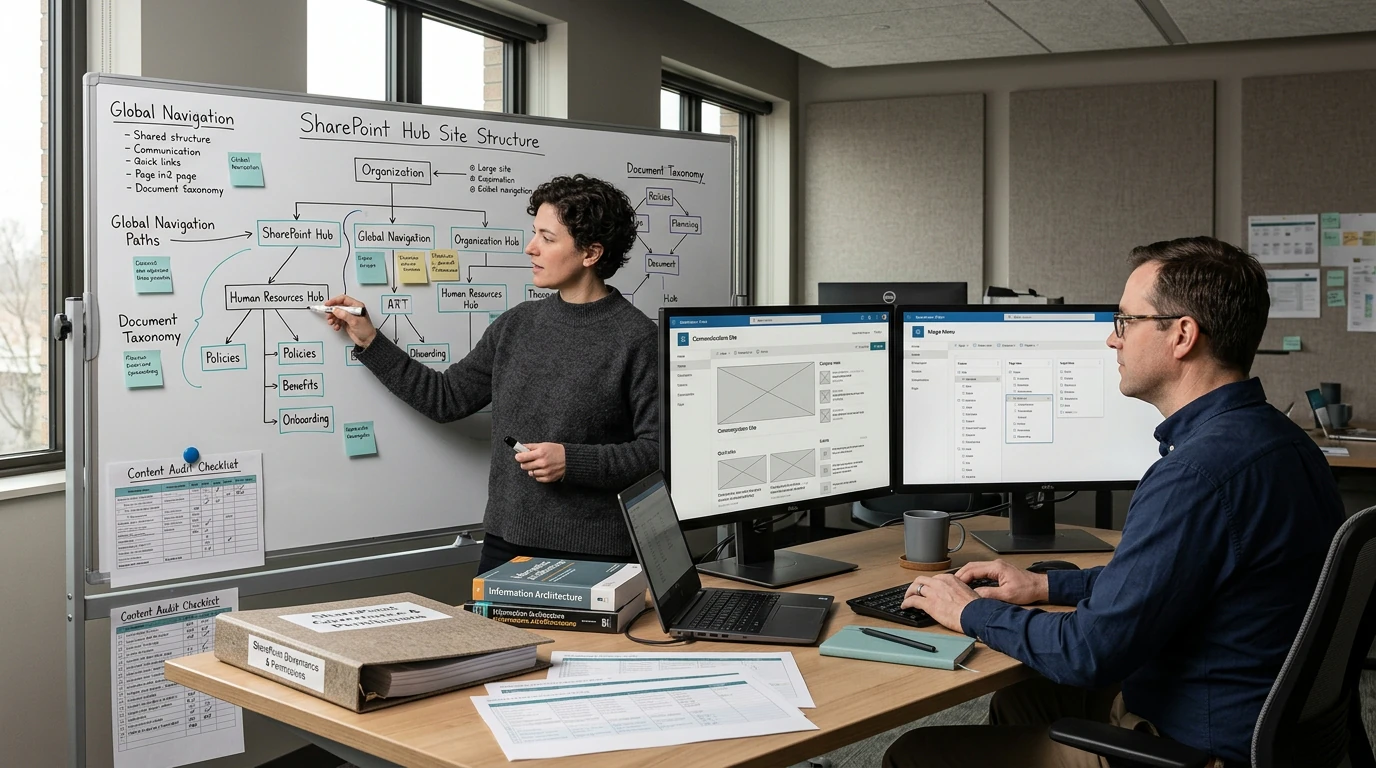
Every company has the folder labyrinth where documents go to die, and the answer to most questions is 'ask Sarah.' A well-architected SharePoint intranet makes knowledge findable and onboarding self-service — inside the licenses you already pay for.
The platform mirrors historical spreadsheets and departmental silos instead of the desired customer lifecycle.
Data definitions, ownership, permissions, automation, and reporting differ across teams and integrations.
Users work around the system because required fields and workflows add effort without returning useful context.
We connect diagnosis, scope, execution, validation, and operational ownership. The package changes the depth and scale—not the discipline of the delivery system.
We confirm the desired outcome, users, current state, dependencies, risks, and evidence of success before prescribing sharepoint intranet & portals.
We translate information architecture workshop and hub, site, and navigation design into visible decisions, responsibilities, milestones, and review criteria.
Delivery moves through reviewable increments with quality checks, exception handling, and stakeholder decisions recorded before they become rework.
We complete owner training and governance guide, confirm handoff and escalation paths, and leave a practical measurement and improvement plan.
Every tier keeps the core controls below. Package level changes the volume, depth, complexity, or operating cadence.
Information architecture workshop
Hub, site, and navigation design
Document library structure and permissions
Branded modern pages and news setup
Owner training and governance guide
The visible deliverable is rarely the whole system. These are the recurring gaps we design out before they become delay, rework, or risk.
Configuring objects and automation before agreeing on lifecycle stages, handoffs, data standards, and decisions.
Migrating duplicates, obsolete fields, and inconsistent history without rules for reconciliation and validation.
Launching with technical training but no role-specific adoption, governance, backlog, or reporting ownership.
Our advantage is not a claim that trade-offs disappear. It is the ability to connect the decisions other providers often split apart, make quality visible, and leave ownership clear.
The operating process and decision model are designed before the platform is configured.
Data, permissions, integrations, automation, reporting, and adoption are planned as one implementation.
Migration and launch use rehearsal, reconciliation, acceptance tests, and a controlled support period.
Scope advantage: The scope makes information architecture workshop explicit, then connects it to hub, site, and navigation design; those dependencies are less likely to disappear between separate vendors.
Final targets are set during alignment, using a baseline, a named owner, and a realistic measurement window. Typical measures include:
Adoption and required-data completeness
Handoff time and automation success
Pipeline, service, or lifecycle reporting accuracy
Team Intranet
Secure USD checkout powered by Stripe. By continuing, you agree to our Terms, Refund & Cancellation Policy, and Delivery Policy. Charges appear as SYNCOGNIX.
Company Intranet
Secure USD checkout powered by Stripe. By continuing, you agree to our Terms, Refund & Cancellation Policy, and Delivery Policy. Charges appear as SYNCOGNIX.
Digital Workplace
Secure USD checkout powered by Stripe. By continuing, you agree to our Terms, Refund & Cancellation Policy, and Delivery Policy. Charges appear as SYNCOGNIX.
Not sure which package fits? Build a guided project brief. We will use your goal, current stage, timing, and investment range to recommend the right package or a strategy session.
Yes — with restructuring, not lift-and-dump. Moving the mess without fixing the architecture just relocates the problem.
Named owners, simple governance rules, and a structure that mirrors how people ask questions — all deliverables, not afterthoughts.
No — SharePoint is included in Microsoft 365 business plans. This is pure configuration and architecture value on licenses you own.