1
Running a scan or buying a tool without defining assets, threat scenarios, business impact, and remediation ownership.
Loading Syncognix
Loading Syncognix
Secure code review, dependency auditing, and security hardening for the software your business builds or commissions.
Secure code review, dependency auditing, and security hardening for the software your business builds or commissions.
The goal is not simply to complete a list of tasks. It is to remove a specific operational or customer constraint, prove the result, and leave clear ownership after delivery.
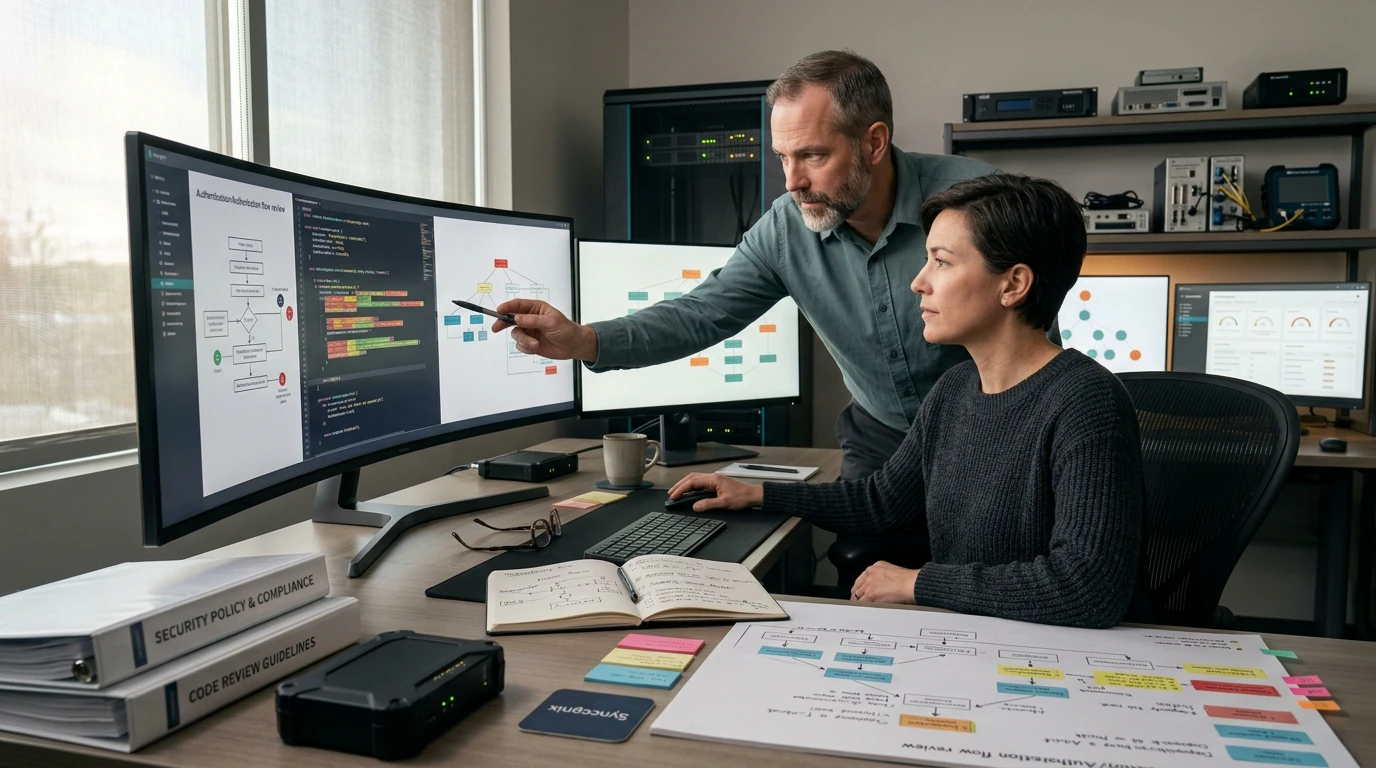
One accountable team connecting the decisions, quality checks, and handoff required for a durable result.
Your developers ship features; attackers read the same code looking for the one unsanitized input. Application security review catches injection flaws, broken access control, and vulnerable dependencies before they become disclosure emails.
Controls are purchased independently, leaving gaps between identity, endpoints, applications, network, people, and response.
Compliance evidence is assembled at deadline instead of produced by normal operating processes.
Alerts and findings accumulate without risk-based ownership, remediation deadlines, or proof that fixes work.
We connect diagnosis, scope, execution, validation, and operational ownership. The package changes the depth and scale—not the discipline of the delivery system.
We confirm the desired outcome, users, current state, dependencies, risks, and evidence of success before prescribing application security & code review.
We translate manual secure code review of critical paths and dependency and supply-chain audit into visible decisions, responsibilities, milestones, and review criteria.
Delivery moves through reviewable increments with quality checks, exception handling, and stakeholder decisions recorded before they become rework.
We complete developer-friendly remediation guidance, confirm handoff and escalation paths, and leave a practical measurement and improvement plan.
Every tier keeps the core controls below. Package level changes the volume, depth, complexity, or operating cadence.
Manual secure code review of critical paths
Dependency and supply-chain audit
Authentication/authorization review
Secrets and configuration audit
Developer-friendly remediation guidance
The visible deliverable is rarely the whole system. These are the recurring gaps we design out before they become delay, rework, or risk.
Running a scan or buying a tool without defining assets, threat scenarios, business impact, and remediation ownership.
Treating a certification checklist as proof that real attack paths and incident decisions are controlled.
Delivering a long findings report without prioritization, retesting, executive context, or an achievable improvement plan.
Our advantage is not a claim that trade-offs disappear. It is the ability to connect the decisions other providers often split apart, make quality visible, and leave ownership clear.
Security work is anchored to assets, plausible threats, business impact, and evidence—not fear or tool volume.
Findings include severity, exploitability, ownership, remediation guidance, and validation criteria.
Technical controls, policies, people, vendors, compliance evidence, and incident readiness are connected.
Scope advantage: The scope makes manual secure code review of critical paths explicit, then connects it to dependency and supply-chain audit; those dependencies are less likely to disappear between separate vendors.
Final targets are set during alignment, using a baseline, a named owner, and a realistic measurement window. Typical measures include:
Critical exposure and remediation time
Control coverage and evidence freshness
Detection, containment, and recovery performance
Focused Review
Secure USD checkout powered by Stripe. By continuing, you agree to our Terms, Refund & Cancellation Policy, and Delivery Policy. Charges appear as SYNCOGNIX.
Deep Review
Secure USD checkout powered by Stripe. By continuing, you agree to our Terms, Refund & Cancellation Policy, and Delivery Policy. Charges appear as SYNCOGNIX.
Secure SDLC
Secure USD checkout powered by Stripe. By continuing, you agree to our Terms, Refund & Cancellation Policy, and Delivery Policy. Charges appear as SYNCOGNIX.
Not sure which package fits? Build a guided project brief. We will use your goal, current stage, timing, and investment range to recommend the right package or a strategy session.
JavaScript/TypeScript, Python, PHP, Java/C#, Go, and mobile (Swift/Kotlin) — plus the infrastructure code around them.
Yes — pre-acceptance security review of contracted work is a common and smart use; you'll get leverage to make the vendor fix findings on their dime.
Pen testing probes the running application from outside; code review reads the source from inside. They find different bugs — high-stakes apps eventually want both.