1
Measuring only ticket closure while ignoring recurrence, user impact, asset health, and root causes.
Loading Syncognix
Loading Syncognix
A modern business phone system inside Teams or best-in-class VoIP — auto-attendants, call queues, and numbers that follow your team anywhere.
A modern business phone system inside Teams or best-in-class VoIP — auto-attendants, call queues, and numbers that follow your team anywhere.
The goal is not simply to complete a list of tasks. It is to remove a specific operational or customer constraint, prove the result, and leave clear ownership after delivery.
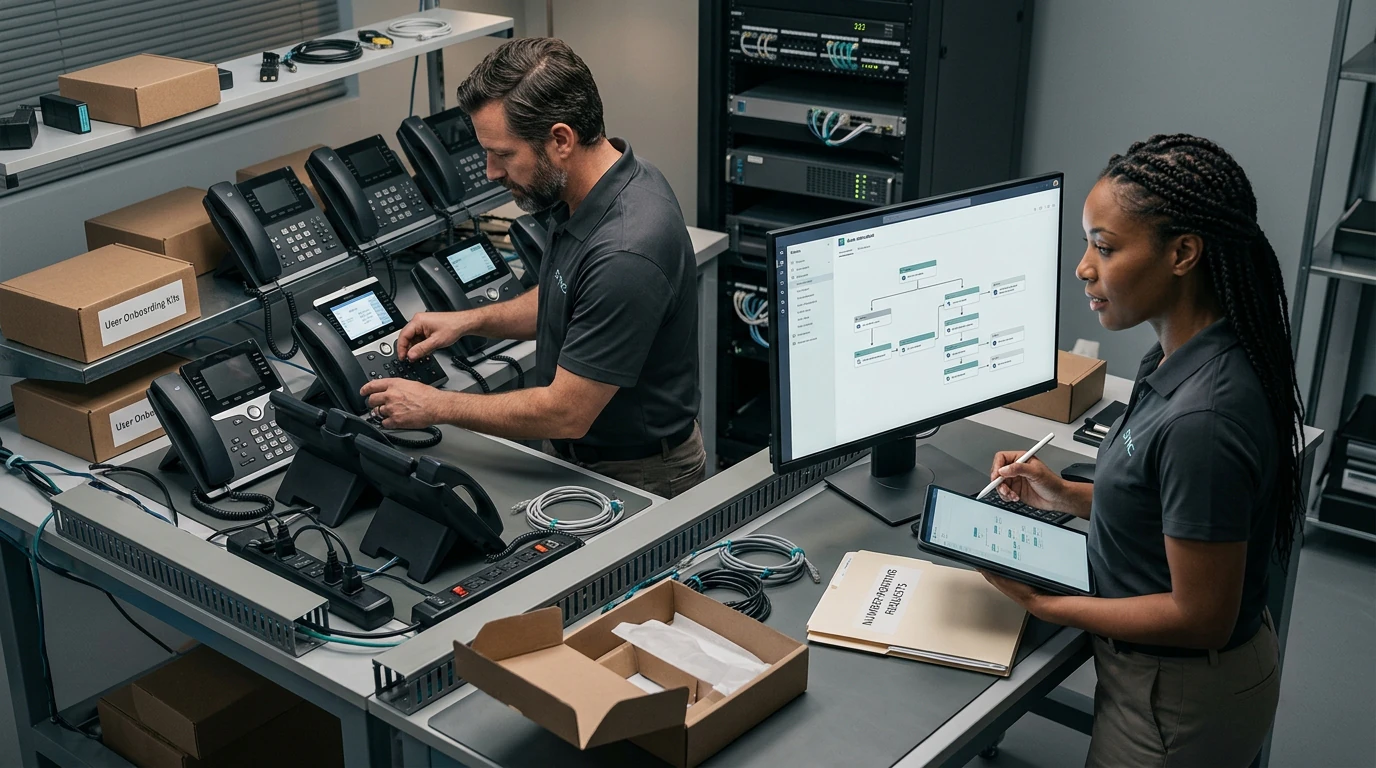
One accountable team connecting the decisions, quality checks, and handoff required for a durable result.
Desk phones tied to desks make no sense for hybrid teams, and the old PBX contract renews itself out of inertia. Modern VoIP puts your business number on every laptop and mobile — with queues, attendants, and recording — usually for less.
Support is reactive, so recurring incidents, aging assets, access gaps, and user friction remain unresolved.
Devices, identities, networks, vendors, licenses, and documentation have different or missing owners.
Employee changes and emergency access depend on informal knowledge rather than controlled, auditable workflows.
We connect diagnosis, scope, execution, validation, and operational ownership. The package changes the depth and scale—not the discipline of the delivery system.
We confirm the desired outcome, users, current state, dependencies, risks, and evidence of success before prescribing microsoft teams phone & voip.
We translate number porting (keep your numbers) and auto-attendant and call queue design into visible decisions, responsibilities, milestones, and review criteria.
Delivery moves through reviewable increments with quality checks, exception handling, and stakeholder decisions recorded before they become rework.
We complete team training, confirm handoff and escalation paths, and leave a practical measurement and improvement plan.
Every tier keeps the core controls below. Package level changes the volume, depth, complexity, or operating cadence.
Number porting (keep your numbers)
Auto-attendant and call queue design
User provisioning and device setup
Call flow testing before cutover
Team training
The visible deliverable is rarely the whole system. These are the recurring gaps we design out before they become delay, rework, or risk.
Measuring only ticket closure while ignoring recurrence, user impact, asset health, and root causes.
Deploying tools without accurate inventory, standard configurations, access policy, and maintenance ownership.
Relying on one administrator without current documentation, escalation coverage, or tested continuity procedures.
Our advantage is not a claim that trade-offs disappear. It is the ability to connect the decisions other providers often split apart, make quality visible, and leave ownership clear.
Support, assets, identity, vendors, network, documentation, security, and lifecycle work share one operating view.
Recurring issues become improvement actions with ownership rather than an endless stream of closed tickets.
Standards, runbooks, access controls, and reporting reduce dependence on individual memory.
Scope advantage: The scope makes number porting (keep your numbers) explicit, then connects it to auto-attendant and call queue design; those dependencies are less likely to disappear between separate vendors.
Final targets are set during alignment, using a baseline, a named owner, and a realistic measurement window. Typical measures include:
Resolution time and ticket recurrence
Device, patch, and identity coverage
Employee uptime and satisfaction
Small Team
Secure USD checkout powered by Stripe. By continuing, you agree to our Terms, Refund & Cancellation Policy, and Delivery Policy. Charges appear as SYNCOGNIX.
Business Phone
Secure USD checkout powered by Stripe. By continuing, you agree to our Terms, Refund & Cancellation Policy, and Delivery Policy. Charges appear as SYNCOGNIX.
Contact Ready
Secure USD checkout powered by Stripe. By continuing, you agree to our Terms, Refund & Cancellation Policy, and Delivery Policy. Charges appear as SYNCOGNIX.
Not sure which package fits? Build a guided project brief. We will use your goal, current stage, timing, and investment range to recommend the right package or a strategy session.
No — porting keeps every number; we manage the process and time the cutover so calls never bounce.
Teams Phone if you live in Microsoft 365 (one app, one vendor); dedicated VoIP (e.g. RingCentral-class) for heavier call-center needs. We implement both — the consultation picks honestly.
Calling plans run USD $8–20/user/mo paid to the carrier/platform. No margin games from us — you see the real rates.