
1
Hiring for available hours before defining the workflow, expected result, service level, and owner.
Loading Syncognix
Loading Syncognix
A dedicated assistant for the daily grind of running a store — product listings, order processing, inventory updates, returns, and customer messages.
A dedicated assistant for the daily grind of running a store — product listings, order processing, inventory updates, returns, and customer messages.
The goal is not simply to complete a list of tasks. It is to remove a specific operational or customer constraint, prove the result, and leave clear ownership after delivery.
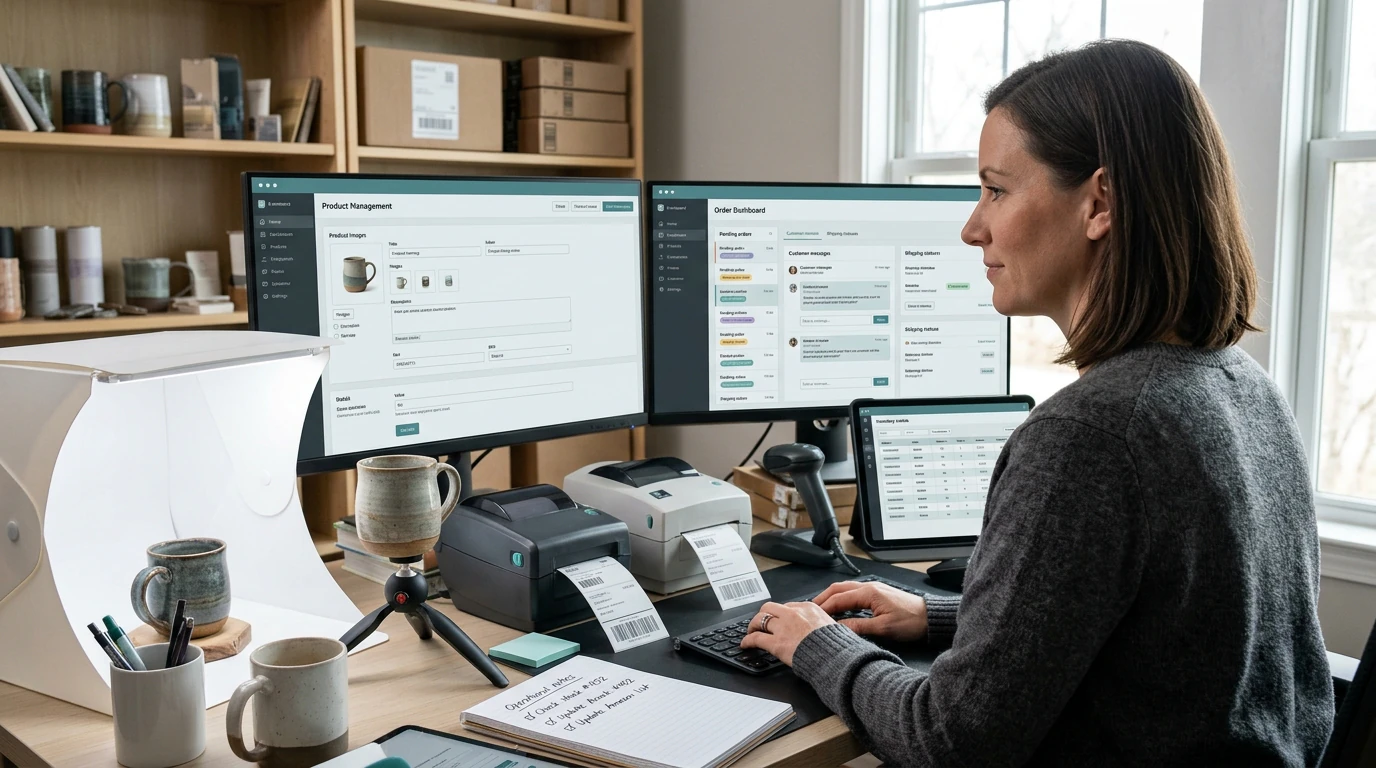
One accountable team connecting the decisions, quality checks, and handoff required for a durable result.
An online store is a hundred small tasks a day: uploading products, fixing listings, processing orders, updating stock, answering 'where's my package.' None of it is hard, all of it is constant, and every hour you spend on it is an hour you're not growing the business. A store assistant runs the floor so you can run the company.
Important recurring work lives in inboxes, memory, and undocumented habits, creating delay and inconsistent output.
Leaders and specialists spend high-value time on coordination, records, research, and follow-up.
Delegation fails when priorities, access, decision rights, quality standards, and escalation rules are implicit.
We connect diagnosis, scope, execution, validation, and operational ownership. The package changes the depth and scale—not the discipline of the delivery system.
We confirm the desired outcome, users, current state, dependencies, risks, and evidence of success before prescribing e-commerce store assistant.
We translate product listing creation and optimization and order processing and fulfillment coordination into visible decisions, responsibilities, milestones, and review criteria.
Delivery moves through reviewable increments with quality checks, exception handling, and stakeholder decisions recorded before they become rework.
We complete store housekeeping across your channels, confirm handoff and escalation paths, and leave a practical measurement and improvement plan.
Every tier keeps the core controls below. Package level changes the volume, depth, complexity, or operating cadence.
Product listing creation and optimization
Order processing and fulfillment coordination
Inventory and stock-level updates
Returns, refunds, and customer messages
Store housekeeping across your channels
The visible deliverable is rarely the whole system. These are the recurring gaps we design out before they become delay, rework, or risk.
Hiring for available hours before defining the workflow, expected result, service level, and owner.
Granting broad access without least privilege, credential controls, confidentiality rules, and auditability.
Measuring busyness or online presence rather than accuracy, timeliness, backlog, and completed outcomes.
Our advantage is not a claim that trade-offs disappear. It is the ability to connect the decisions other providers often split apart, make quality visible, and leave ownership clear.
We turn recurring work into documented queues, priorities, service levels, quality checks, and escalation paths.
Access and communication are structured around least privilege, confidentiality, and visible ownership.
The engagement is managed by outcomes and operating rhythm rather than activity alone.
Scope advantage: The scope makes product listing creation and optimization explicit, then connects it to order processing and fulfillment coordination; those dependencies are less likely to disappear between separate vendors.
Final targets are set during alignment, using a baseline, a named owner, and a realistic measurement window. Typical measures include:
Backlog and turnaround time
Accuracy and rework rate
Internal hours returned to higher-value work
Single Store
Secure USD checkout powered by Stripe. By continuing, you agree to our Terms, Refund & Cancellation Policy, and Delivery Policy. Charges appear as SYNCOGNIX.
Multi-Channel
Secure USD checkout powered by Stripe. By continuing, you agree to our Terms, Refund & Cancellation Policy, and Delivery Policy. Charges appear as SYNCOGNIX.
Scale
Secure USD checkout powered by Stripe. By continuing, you agree to our Terms, Refund & Cancellation Policy, and Delivery Policy. Charges appear as SYNCOGNIX.
Not sure which package fits? Build a guided project brief. We will use your goal, current stage, timing, and investment range to recommend the right package or a strategy session.
Shopify, WooCommerce, BigCommerce, and Squarespace stores, plus Amazon, Etsy, eBay, and Walmart marketplaces. If you sell somewhere with a login and a dashboard, we can most likely run the daily operations in it.
That service is strategy and growth — advertising, buy-box, listing optimization to sell more. This is the operational hands that keep the store running day to day. Sellers scaling on Amazon often use both.
Yes — order status, returns, and product questions in your voice, following your policies. Anything outside their authority (unusual refunds, complaints) is escalated to you with the full context attached.